Council for Court Excellence – A Great Resource for Legal Consumers

The Council for Court Excellence (CCE), the “moving force” behind the “one day/one trial” jury duty system in the D.C. Superior Court, is a nonprofit organization formed in 1982, that “works to improve the administration of justice in the Washington metropolitan area and in the nation.”  CCE’s work includes a number of initiatives that help legal consumers gain better access to justice.

Logo courtesy of Council for Court Excellence

Logo courtesy of Council for Court Excellence

CCE’s initiatives in the areas of criminal justice, children in the justice system, civil justice, and community education and access to justice are accomplished by:

  • Identifying and promoting justice system reforms,
  • Improving public access to justice, and
  • Increasing public understanding and support of our justice system.

As part of their work, CCE has published a number of community education booklets that explain, in a straight forward way, certain judicial system processes and how to’s on navigating many of the different courts.  These booklets, almost all of which can be downloaded for free on CCE’s digital library, include the following titles:

  • Community Guide to the Courts
  • Compliments and Complaints Guide
  • When Someone Dies: A Non-Lawyer’s Guide to Probate in Washington, DC
  • Personal Affairs Record Book
  • Guide to the DC Juvenile Justice System
  • A Victim’s Guide to the DC Criminal Justice System

The Community Guide to the Court, as an example, introduces legal consumers to the DC metropolitan area “state” courts and the federal courts, and it provides a useful outline of the procedure for “typical” matters in civil, criminal and juvenile courts.  There is also a glossary of terms to make the “legalese” understandable.

CCE is doing much-needed work to improve justice.  The information on its website and especially in these booklets is a great resource for legal consumers indeed.

You’ve got options.  The Center for Legal Practice Reform can help you navigate the attorney/client relationship and level the playing field.  Call LPR today for a free consultation – (301) 351-7970.

Posted in Reform | Tagged , , , , , , , | Leave a comment

The Client’s Paradox

In today’s times when people need a lawyer to do almost anything, the choice of which lawyer is very important.  But as the number of lawyers to choose from has increased exponentially, the choice has become infinitely more complex.  A similar “paradox” is the subject of an article about certain financial professionals in the most recent issue of Worth magazine.

ParadoxIn “The Investor’s Paradox,” hedge fund analyst Brian Portnoy detailed four “questions to ask before choosing a fund manager.”  These questions are directed toward investors choosing whom to trust with their money.  But these questions are also good examples of questions to ask when hiring a lawyer — simple, straight forward, and brutally honest.  After all, you are choosing whom to trust with your confidences, your problem(s) and your money.  Mr. Portnoy proposes the following questions:

1.     CAN I TRUST YOU?

Citing Bernie Madoff, Mr. Portnoy explains that one bad investment can be devastating to an investor’s portfolio, and that “operational due diligence” is required.  This is equally true about an attorney’s representation.  If your attorney, who holds him/herself out as an expert, files a lawsuit for you, takes it up to trial and the judge determines he/she failed to allege the correct law and dismisses your whole case, that is what Mr. Portnoy would call ” a bomb [that] can ruin” you.  So, before you hire an attorney, you should ask him/her or yourself, “can I trust you?”

2.     WHAT DO YOU DO?

Mr. Portnoy suggests that starting the conversation with this question and asking follow-up questions can help an investor learn the “core investment expectations for the fund,” and possibly learn the risks that fund manager is taking.  Likewise, when meeting an attorney for the first time, ask what they do (i.e., what kind of law do you practice?) and a series of follow-up questions so you can learn more about his/her core work expertise, experience, and ethic and the risks he/she takes.

3.     ARE YOU GOOD AT YOUR JOB?

With this question, Mr. Portnoy advises investors to inquire whether a fund manager is skillful.  He advises that a “satisfying arrangement” is more than the numbers, it is more the “social engagement of managing expectations.”  In other words, “skill is about keeping one’s promises.”  Determining whether an attorney is skillful is incredibly important, and his/her response to this question, especially his/her demeanor, can tell you a lot.

4.     ARE YOU THE RIGHT FIT FOR ME?

This is the first question Mr. Portnoy suggests investors should ask themselves: “What is my objective?”  This is also a question that every client needs to ask him/herself.  Your objective should be ever-present in your mind when thinking about hiring an attorney.  If you want, or expect, that a matter will go to trial, then you need to hire an attorney with credible trial experience.  Nothing is worse than barreling to trial with an attorney at the helm, only to discover that he/she is inexperienced and/or afraid to go to trial.

Some of these questions might be difficult to ask an attorney, but they should at least be kept in mind and considered as part of the hiring process.  Hiring a lawyer today can indeed be paradoxical.  The more informed you are the better.

You’ve got options.  The Center for Legal Practice Reform can help you navigate the attorney/client relationship and level the playing field.  Call LPR today for a free consultation – (301) 351-7970.
Posted in Tips | Tagged , , , , , , , , , , , | Leave a comment

Law Firm Refunds Fees . . . Voluntarily!

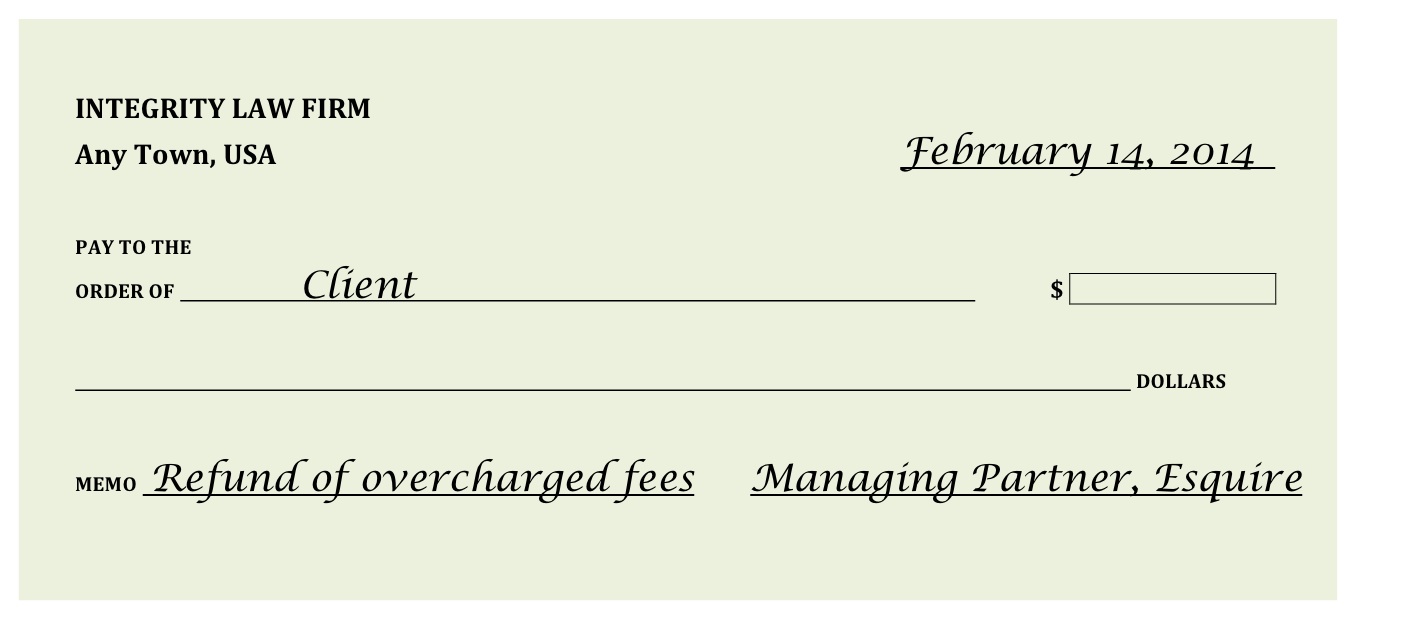
Imagine you hire a high-end law firm to handle a dispute for you.  The firm handles the matter to your satisfaction and, while the bill seems high, you willingly pay the fee.  Now imagine several months later you receive a check from the firm with a letter explaining that, after review of the closed matter, the firm discovered that you were overcharged.

INTEGRITY LAW FIRMHard to believe?  

Well . . . this is a true story.

Receiving a refund of fees after challenging an attorney’s billing is one thing, but a firm that reviews billings from closed cases for possible overcharging, now that’s unique.  We suspect that a number of you are thinking:

I’d hire that firm!

For many clients, just the thought of approaching their attorneys to challenge the billings is stressful.  Will the attorney be insulted?  Will he/she retaliate or be passive-aggressive going forward?  Will he/she charge for discussing the billing issue?  The prospect seems daunting to many.

This legal consumer-friendly action is to be commended.  It would be great if all law firms engaged in this after-the-fact (or during-the-fact) billing review.  And, it would be even better if law firms, especially the large firms, had customer service departments to address client concerns about billings and other issues.  Approaching someone trained in customer services would surely be more welcoming and client-friendly.

Law firms big and small should take note.  A law firm that is honest enough to realize that sometimes clients are over billed, and that has the integrity to refund the overage, would be in great demand indeed.

You’ve got options.  The Center for Legal Practice Reform can help you navigate the attorney/client relationship and level the playing field.  Call LPR today for a free consultation – (301) 351-7970.

Posted in Billing | Tagged , , , , , , , , | Leave a comment

Sitting Judges As Mediators

In Shawnee County District Court, located in Topeka, Kansas, sitting judges are mediating “serious” criminal cases.  According to The Topeka Capital-Journal, this mediation program is a growing trend that is avoiding “legal warfare,” alleviating the need for victim and witness testimony, and sparing court, law enforcement and attorney resources.  The February 2, 2014 article, titled “Judges acting as mediators in serious criminal cases more often,” quotes one judge as saying that the goal is “to bring as much justice as you can to as many people as you can.”

MEDIATIONThis mediation program started in April 2013, after a “full house” of Shawnee County judges, prosecutors and defense attorneys attended a course on mediating criminal cases taught by their counterparts from a neighboring county.  Mediation occurs only when the prosecutor and defense attorney agree they want a judge to mediate the case.  The case then proceeds under the following conditions:

  • The judge mediator has to be neutral and “not have a dog in the fight.”
  • The judge assigned to handle a criminal case can’t be the judge mediating that case.
  • The prosecutor and defense attorney can’t talk to the assigned judge about the strengths and weaknesses of their case . . . . But it is fair for the attorneys to talk to another judge assigned to mediate the case.
  • Each side can lay out the strengths and weaknesses of his or her case, and the mediating judge can give feedback to each side.
  • At the same time, the mediator judge doesn’t disclose what the prosecutor or defense attorney has told the judge.

Judicial mediation in Shawnee County is touted as “a rare opportunity for [criminal defendants] to talk to a judge, to tell the judge what they think their story is.”  After mediation, defendants can make a plea or go on to trial.  Of the seven cases that the court mediated since April, it is reported that all seven resulted in pleas in four hours or less, saving the court seven trials, each of which could have lasted days or even weeks.

Reform is clearly needed in criminal matters.  If indeed this mediation program furthers actual justice in an efficient and victim friendly way, this program appears to be a step in the right direction.

Posted in Reform | Tagged , , , , , , , , | Leave a comment

Attorney Tip #5 – Talk Like A Lawyer

No, we don’t mean speak to your clients using “legalese.”  We mean the exact opposite. On January 1, 2012, the ABA Journal re-published “More Than Just Words: This Is What It Really Means to Talk Like a Lawyer” by Jim McElhaney.  Mr. McElhaney, a law professor and the ABA Journal’s Litigation columnist, was leaving the Journal after 25 years when this article was re-published.  The article originally appeared in the Journal’s September 1991 issue.

Document4In the article, Mr. McElhaney recounts the story of a young attorney trying to persuade a large corporate client to adopt a novel and risky position and of the young attorney’s miserable failure.  On the ride back from the client meeting, the young attorney’s supervisor explained to him how to talk like a lawyer.  Years later, that young attorney, then a supervisor himself, gave the same speech to a young attorney in Mr. McElhaney’s presence.  Mr. McElhaney in turn bestowed the wisdom on his readers in 1991.  Here are some of the highlights:

  • Bond With Your Audience – Pleasing your audience is the key to persuading it. . . . One of the strongest bonds a lawyer can draw on is the very reason for everyone being in court in the first place: to right a wrong. 
  • Accept Responsibility – It is your job to make yourself understood—not your audience’s job to try to understand you. . . . Focus on your audience . . . . Respect your audience . . . . Treat them as equals.
  • Create A Perception of Credibility – Talk only about what you know. Whenever you try to fake it, little verbal and nonverbal clues will give you away.
  • Have Something To Say – You need a point of view, a story with an object, a theme. You need to have something to say.
  • Show, Don’t Tell – If a point is worth making, it is worth illustrating. Good examples—apt analogies—are more precious than rubies.
  • Keep It Simple – The art of simplicity is not only knowing how everything fits together, but also knowing what can safely be discarded. And this is where lawyers have trouble. . . . Forget the exceptions unless they are directly relevant to what you are doing. Your function is not to cover everything; it is to make a focused presentation.
  • Make A Memory – Usually your goal is not to impress your audience with what a fine speaker you are, but rather to persuade. And that means the memories you create should be vivid word pictures—sometimes even uncomfortably vivid word pictures—that will argue your case for you.
  • Stop – When you are done, stop. Afterthoughts, recapitulations, repetitive exhortations and the dismal trailing off by the speaker who is not certain he has finished cost more than whatever they could possibly add to a presentation. It’s much better to leave your audience thinking they want more than knowing they have heard too much.

Wise words indeed.

You’ve got options.  The Center for Legal Practice Reform can help you navigate the attorney/client relationship and level the playing field.  Call LPR today for a free consultation – (301) 351-7970.

Posted in Tips | Tagged , , , , , , , , | Leave a comment

Manhattan Judge Rules For The Legal Consumer – Again!

Manhattan Civil Court Judge Frank P. Nervo issued an opinion on January 14, 2014 denying a law firm’s $126,000+ legal fee request for recovery of a $6,400 security deposit in a residential lease case.  The “BigLaw” firm, Mayer Brown LLP, submitted the 14 page bill to the court for approval, which under the lease, is chargeable to the tenants. LPR posted a previous ruling from Judge Nervo, which required an attorney to repay his clients for overcharging them, plus interest.

Map of NY City Counties

Map of NY City Counties

In an eight (8) page opinion, Judge Nervo outlined examples of Mayer Brown’s “duplicated effort,” research of “the most basic and banal legal principles,” unreasonable charges for “oversight (of an associate attorney) by a more senior associate . . . and a partner,” and “duplicative and unnecessary fees” that the firm “unabashedly invoiced.”  The examples cited by the judge included charging for:

  • [L]egal matters about which counsel is presumed to know and tasks that, even were they necessary, could have been performed within minutes. The court cannot discern any need to research the topic of real estate licensing, as it has nothing to do with the legal issue in question.
  • While legal research may be billed for under appropriate circumstances, merely reading a court rule is not research.
  • [T]he basis upon which any attorney can actually occupy himself or herself over seven hours reviewing this nominal and uncomplicated material (reviewing documents related to the security deposit), in a simple case like this, defies imagination.
  • This court cannot envision the inordinate circumstances under which any trial of this matter – had it gone to trial – would extend beyond sixty minutes . . . . Thus, the court can find no reasonable basis for this excessive allocation of (4-3/4) hours and the resultant fee.
  • The Notice of Inquest is a one-sided Blumberg form requiring the preparer to add the caption of the matter, check off two boxes, and answering a series of eight rather basic questions to assure compliance with pretrial procedures, all of which were correctly noted as “Not Applicable” in this case.  To demand compensation for two hours of professional or non-professional time over three days to accomplish this essentially ministerial task, asserting it required researching, drafting, conversing, conferring and discussing of some sort, the court finds unbelievable.
  • [A]t least fifty-two-and-one-half (52.5) hours of time were singularly devoted to preparing a simple opposition to an order to show cause seeking vacatur of a default judgment. This is a stunningly inordinate amount of time for such a simple task, and there is no basis to award compensation based on this incredible claim.

Judge Nervo’s final words on the matter:

To move any court to put its imprimatur of approval on such practices is simply intolerable.  Under these circumstances, this court cannot and will not award any fees.

Once again, LPR applauds Judge Nervo for taking an unbiased look at the attorney billings and for having the courage and conviction to put those findings in writing and into the public domain.  It is hard as a layperson to know what tasks attorneys should be billing for and how long tasks should take.  So, legal consumers should read Judge Nervo’s opinion.  It provides solid examples of inappropriate billing.

You’ve got options.  The Center for Legal Practice Reform can help you navigate the attorney/client relationship and level the playing field.  Call LPR today for a free consultation – (301) 351-7970.

 
Posted in Billing | Tagged , , , , , , | Leave a comment

Robbing The Elderly . . . Sanctioned By The Court?

A guardian, conservator, or other-termed fiduciary, often an attorney, is appointed by the court when certain elders (and others) are incapable of caring for themselves and/or their property, and they need protection.  But who protects these elders when the fiduciaries are the ones taking advantage?

flicker (photo credit: Horia Varlan)

flicker (photo credit: Horia Varlan)

Certainly, not all fiduciaries take advantage, and LPR applauds those who discharge their duties with honesty and integrity.  But instances of fiduciaries taking advantage is more prevalent than one would think.  In those instances, the fiduciaries’ access is largely unchecked, and in too many cases, sanctioned by the court.

The case of Marie Long of Arizona is a classic example. Mrs. Long’s plight was investigated and reported by Laurie Roberts of azcentral.com in a December 17, 2013 post titled, “Widow ‘protected’ into the poorhouse gets some of her money back (finally).”  According to the post, Mrs. Long was widowed in 2003 and at the time was worth $1.3 million.  In 2005, she suffered a stroke, and a subsequent family dispute over her care brought her before the Maricopa County Probate Court.  The court-appointed fiduciary and the lawyers billed Mrs. Long more than $1 million.  The court approved the billings.  Within a matter of a few years, Mrs. Long was in a nursing home that accepts welfare residents.

When attorneys who volunteered their time to help Mrs. Long challenged the billings, the court “lambasted” them, calling their challenges to the billings “venomous” and charging that the attacks forced the fiduciaries and lawyers to defend themselves . . . with Mrs. Long’s money.

Ms. Roberts’ investigative reporting uncovered that the court had sent advance copies of its rulings to the court-appointed attorneys.  And, while the Arizona Court of Appeals found that the lower court acted unethically and deemed what happened to Mrs. Long “inexcusable,” it did not fix what happened to her.  Rather, Mrs. Long received a small settlement.

Sadly, Mrs. Long’s story is not novel.  Elders under the eyes of the court are often taken advantage of, and when the courts appoint fiduciaries from their approved lists, there is often a tendency to give them leeway and even protect them, at the expense of the elder.

When society’s most vulnerable gets taken advantage of, the system allowing the abuse needs to be reformed.  LPR applauds Ms. Roberts for shining a light on this abuse.  Hopefully this is a wakeup call for the probate courts and the fiduciaries.  After all, those tasked with protecting the elderly should not take advantage of them, and those tasked with overseeing the fiduciaries should not sanction their mistreatment of the elderly.

Posted in Reform | Tagged , , , , , , , , , , , , , , | Leave a comment

The End Of An Era?

We returned to the office from holiday Monday morning only to learn that Senior U.S. District Judge Richard Kopf is leaving the blogosphere.  Judge Kopf’s blog, Hercules and the Umpire, may only have been active for less than a year, but it is filled with judicial insights that legal consumers should read.  We previously wrote about Judge Kopf in our post, Judge Richard Kopf: As Inspirational As The Robber Turned Law Clerk He Sentenced To Prison.  We are sad to see the judge go, but we are so thankful that he gave us a glimpse.  The judge notes in his final post, Happy New Year and Farewell, that while he will no longer post to the blog, he will leave the blog up as an archive.

Thinking of the hole that Judge Kopf’s blog retirement would leave, we searched the web for other judicial blogs and stumbled upon Robert Ambrogi’s blog, LawSitesBlog.com, and his April 26, 2013 post titled, A Quick Survey of Blogs Written By Judges.  The post identifies a number of judicial blogs (including international ones) — many of which are no longer active.  Below are some of the currently active blogs written by judges in the United States cited by Mr. Ambrogi:

While some of the information on these blogs are state-law specific, they provide a wealth of general information for legal consumers.  Information about the law, procedure and judicial perspective is sometimes hard to find.  These blogs are good resources.

LPR thanks Judge Kopf for sharing his thoughts with the blogosphere this past year, and we wish him all the best in the future.  We hope that Judge Kopf’s blog and the blogs listed above encourage more judges to reach out and inform the public.

You’ve got options.  The Center for Legal Practice Reform can help you navigate the attorney/client relationship and level the playing field.  Call LPR today for a free consultation – (301) 351-7970.

Posted in Reform | Tagged , , , , , , , , , , , | Leave a comment

Law Firm Pays It Forward; LPR Closed For Holidays

We at LPR are always looking for inspiring stories to spur legal reform.  This holiday season, we stumbled on the story of a law firm that started a holiday program to encourage others to do good deeds and pay it forward.  On December 18, 2013, Fayobserver.com reported about a local law firm’s holiday program: Fayetteville Law Firm Spurs ‘Pay It Forward’ Deeds All Over City.

Poinsettas

Poinsettas (Photo credit: David Noah1)

According to the article, the Hutchens Law Firm of North Carolina distributes cards to the public as part of its “High Performance Giving” campaign.  The card recipient is prompted to do a good deed for someone and pass the card to them.  That person is asked to do a good deed for someone else and pass the card to them, and so on.  Each person who does a good deed and posts it on the firm’s campaign website, Highperformancegiving.com, is eligible for a weekly $100 gift card from the firm.  According to the firm’s marketing director, the firm wanted to expand its charitable giving program in a way that would allow the public to do good deeds even if they couldn’t afford to give financially:

Not a lot of people are doing good deeds for others, especially in this giving season.  It should be put out there more that it’s okay to do good deeds for others and that it doesn’t have to cost you money.

The website lists many good deeds by card recipients, from paying for someone’s coffee, to giving a homeless person breakfast, to getting tested to be a kidney donor for a 9-year-old girl.  The website is full of kind acts big and small.

While the possibility of a reward or recognition should not be the reason one does a good deed and the program could merely be a marketing endeavor, LPR applauds the firm for thinking up and instituting the program.  Hopefully other firms will take note and begin to think of ways to pay it forward to their clients and to the public.

LPR will be closed starting December 23 and will reopen January 6, 2014.  We at LPR wish everyone a holiday season filled with joy and a dispute-free New Year.

Posted in Reform | Tagged , , , , , , | Leave a comment

Judicial Assistance For Litigants Without Lawyers?

The D.C. Commission on Judicial Disabilities and Tenure recently called out a D.C. Superior Court judge seeking senior status for “discourteous and impatient treatment of litigants.”  The Commission was created in 1970 to oversee the conduct of D.C.’s judges.   Reading the Commission’s findings of that investigation, LPR is reminded of the court’s revised Judicial Code of Conduct adopted in 2012.  The new version allows judges of that court to provide limited assistance to litigants who represent themselves.

Gladys Kessler

Gladys Kessler (Photo credit: Wikipedia)

According to a December 4, 2013 post on BLT: The Blog of LegalTimes, titled D.C. Judge Reproached for ‘Inappropriate’ Comments, D.C. Superior Court Judge Natalia Combs Greene’s request for senior status appointment following her retirement was met with “numerous” complaints about her “rude” and “intimidating” manner towards litigants.  Although the Commission ultimately recommended Judge Greene for senior status, U.S. District Judge Gladys Kessler, the Commission’s chairperson, detailed Judge Greene’s courtroom demeanor in a November 13, 2013 letter, and suggested limitations on her subsequent appointment:

Though the Commission found many aspects of Judge Combs Greene’s performance over the past 15 years to be most favorable, the Commission would be remiss if it did not address the serious issue of the Judge’s demeanor, particularly in one assignment. . . . It is clear from our review of the cases brought to our attention, that Judge Combs Greene’s demeanor was oftentimes less than courteous, and on occasion even rude and intimidating; moreover some of her comments during those proceedings were exceedingly inappropriate. This causes the Commission great concern.

The Commission is aware of the enormous challenges judges face while presiding in high volume Courts such as Landlord & Tenant. Despite the frustration a judge may feel, a raised voice, impatient tone, or off-handed remark only makes the situation more stressful and tense for the litigants and more difficult for the judge. . . . Every litigant deserves to be treated with the utmost respect.

LPR applauds the Commission’s public acknowledgment of litigant complaints and for not sweeping them under the rug.  LPR is also encouraged by the revisions to Rule 2.6 of D.C. Court’s Code of Judicial Conduct, allowing judges to assist litigants who represent themselves.  Comment 1A to Rule 2.6 explains the scope of permissible assistance (emphasis added):

[1A] The judge has an affirmative role in facilitating the ability of every person who has a legal interest in a proceeding to be fairly heard. Pursuant to Rule 2.2, the judge should not give self-represented litigants an unfair advantage or create an appearance of partiality to the reasonable person; however, in the interest of ensuring fairness and access to justice, judges should make reasonable accommodations that help litigants who are not represented by counsel to understand the proceedings and applicable procedural requirements, secure legal assistance, and be heard according to law. In some circumstances, particular accommodations for self- represented litigants may be required by decisional or other law. Steps judges may consider in facilitating the right to be heard include, but are not limited to, (1) providing brief information about the proceeding and evidentiary and foundational requirements, (2) asking neutral questions to elicit or clarify information, (3) modifying the traditional order of taking evidence, (4) refraining from using legal jargon, (5) explaining the basis for a ruling, and (6) making referrals to any resources available to assist the litigant in the preparation of the case.

While not all courts have adopted a similar provision, representing yourself in the D.C. Courts may now be more user-friendly.

You’ve got options.  The Center for Legal Practice Reform can help you navigate the attorney/client relationship and level the playing field.  Call LPR today for a free consultation – (301) 351-7970.

Posted in Reform | Tagged , , , , , , , , | Leave a comment