Attorney Tip #9 – Brief Writing

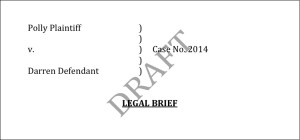
In an ABA Journal article titled “Dirty Dozen: 12 Ways to Write a Really Bad Brief,” Jim McElhaney writes about the “ordinary sins [of bad brief writing] that even good lawyers commit everyday.”  According to Mr. McElhaney, they include:
  1. Polly PlaintiffMake it a “long,” not a brief. There are lots of ways to make a brief too long: too many points, too many citations, too many quotations, too many words.  But what many judges look for is too many pages. Some judges delight in reading only up to the page limit they’ve imposed by local rule and then stopping.
  2. Throw issues against the wall. Too many issues make a bad brief no matter how many—or how few—words it has.
  3. Flunk the giggle test. Seriously pressing a point that doesn’t pass the giggle test is deadly because it undermines your credibility.
  4. Commit purposeful errors. . . . Judges don’t always call lawyers on what they think may be purposeful misstatements because intent is always hard to prove. But judges talk with each other—their club is a small one.
  5. Make unreasonable arguments. The advocacy system is supposed to work when each side makes its strongest arguments. But “strongest” does not mean loudest, longest or most one-sided. Making the best argument you can means being reasonable, logical, fair. Concede the obvious. Not every issue has two good sides to it.
  6. Be bombastic. Exaggerated words go hand in hand with unreasonable arguments.      . . . Here are examples of the kinds of words and phrases you should cross out on the first revision of any brief: manifestlyclearlyfatalclear beyond peradventurelogic that is fatally flawed,egregiouscontumaciousmere gossamermust necessarily failtotally inapposite.
  7. Let Mongo loose. Lambasting the trial judge, the other lawyer, the Supreme Court, Congress, the president, the governor or the state legislature is rarely necessary or even helpful in writing a brief. Even if your readers secretly agree with you, they will still disapprove of using a brief to let fly at your favorite targets.
  8. Lay on the legalese. Aiming for a tone of formality and respect, we almost always go too far and instead create a forest of awkward verbiage.
  9. Load up the citations. Lots of briefs contain lists of authorities that are two or three pages long. When you leaf through the text, you see a daunting bramble bush of quotations and case references on every page. What it says is: “Heavy reading ahead. There is nothing clear about this case. It has a lot of difficult questions that could obviously go either way.”
  10. Quote like crazy. . . . Quotations should be occasional gems that add sparkle to a page. Good quotes make important points in a memorable way. The problem is, good writing is hard to find in most judicial opinions, so quoting from them extensively tends to be deadly.
  11. Don’t analyze. Some brief writers run through statutes and case holdings well enough but never really analyze the case, discuss the issues, show how the rules apply or address the difficulties they raise.
  12. Tell no story. Every brief should tell the story of an injustice, a wrong that needs to be righted or avoided.  The story is central to the way we process facts. It is the basic system we use to teach, to understand, to instill moral precepts and to memorialize important events. Telling an engaging story in the statement of facts and the issues they raise gives meaning to an otherwise dry assemblage of information.  How you do it depends on who you are writing the brief for.
While it is important for attorneys to be aware of these brief writing pitfalls, it is also helpful for legal consumers to understand what contributes to bad brief writing and how it can impact the judges’ decisions.  

Posted in Tips | Tagged , , , , , , , , | Leave a comment

Attorney Tip #8 – Tread Lightly

What do you do when a client posts a negative review on Yelp, Avvo, Martindale Hubbell or another review website?  Do you shoot off a response?  Do you provide your side of the story?  Given what’s at stake, you should tread lightly.

Document4Susan Michmerhuizen, ETHICSearch Research Counsel with the American Bar Association, addressed the thorny issue of negative client reviews on social media in the September 2014 issue of YourABA.  In an article titled, “Client reviews: Your thumbs down may come back around,” Ms. Michmerhuizen poses the hypothetical of a client, who while not truthful about the facts in a custody matter that led to an unfavorable outcome, writes a negative review about the attorney.  The attorney in the hypothetical grapples with whether to reveal the true facts in a response to the review.

The article cautions that although it can be “maddening” for there to be only the client’s version of events, attorneys should not opt for a “scorched earth” response.

In these days of the Internet and social media, remember the “new” adage: Only post materials on the Internet that you wouldn’t mind seeing on the front page of the New York Times. Remember that any reply will live on, past the time when your emotions have cooled down. It will also remain for new clients to see and use to evaluate you. Damage control, not revenge, is the mantra.

Attorneys should carefully consider the consequences to defending themselves in a response.  As explained in the article, the self-defense exception to Rule 1.6 does not apply to online reviews, because they are not “controversies” or “proceedings” as required by the rule.

Suggestions on what to do include letting it go if the post is poorly written and seeking positive reviews from other clients (without any quid pro quo).  In Opinion 2014-200 (2014), the Pennsylvania State Bar ethics committee proposed attorneys consider posting the following response:

A lawyer’s duty to keep client confidences has few exceptions and in an abundance of caution I do not feel at liberty to respond in a point-by-point fashion in this forum. Suffice it to say that I do not believe that the post presents a fair and accurate picture of the events.

Regardless of how untruthful an online review is, tread lightly and consider the long-term implications of shooting off a defensive response.

Posted in Tips | Tagged , , , , , , , , , | Leave a comment

US Department of Justice’s New Elder Justice Initiative

One of LPR’s followers alerted us to the U.S. Department of Justice’s (DOJ) recently launched Elder Justice Initiative.  The DOJ’s Elder Justice Website seeks to help elder abuse victims and their families learn about and report abuse.

seal[T]he United States Department of Justice Elder Justice Website [is] a resource for victims of elder abuse and financial exploitation and their families; practitioners who serve them; law enforcement agencies and prosecutors; and researchers seeking to understand and address this silent epidemic plaguing our nation’s elders.

The site includes a section for elder abuse victims and their family members to locate local resources to assist them in understanding and reporting elder abuse and financial exploitation.

Here, victims and family members will find information about how to report elder abuse and financial exploitation in all 50 states and the territories. Simply enter your zipcode to find local resources to assist you.

Also included for victims and family members are frequently asked questions, common scenarios and information on training.

There are also pages that include resources for prosecutors, researchers and practitioners.  For prosecutors there are three databases:

(1) federal pleadings and corporate integrity agreements (2) state pleadings, and (3) multiple elder justice statutes governing civil and criminal financial exploitation, mandatory reporting requirements and long-term care regulations.

For researchers (and others interested), there is a searchable database of “scientific, legal and general literature concerning elder abuse”:

over 2400 abstracts and publications . . . searchable by specific topics of interest in elder abuse. . . . [and] a bibliography of all the articles in the database.

The website also includes resources for practitioners, including legal providers, the police, judges, medical and care providers, and medical examiners.  These include a series of DVDs, online training, and publications.

This is a great website that is easily navigated.  Links to all of the above resources can be found on the website.

Mistreatment of elders is frightfully common and underreported.  LPR applauds the DOJ for providing this much-needed resource.

Posted in Reform | Tagged , , , , , , | Leave a comment

LPR Seminar on September 30, 2014

Elisa Eisenberg, Founder and CEO of Center for Legal Practice Reform (LPR), will be giving a seminar for Washington Metropolitan OASIS, titled Need A Lawyer? How to Navigate the Attorney/Client Relationship.  The seminar will take place on Tuesday, September 30, 2014 from 1:00 p.m. to 2:30 p.m. at OASIS’ offices, located at Macy’s Home Store in Westfield Montgomery Mall, 7125 Democracy Boulevard, Bethesda, Maryland, 20817.

newlogoLPR’s seminar description can be found on page 16 of OASIS’ Fall 2014 Catalogue:

Almost every person, business, and organization will, at one time or another, need the services of a lawyer. All will choose an attorney that they likely do not know, assume they will be well represented, and believe their issue will be resolved satisfactorily for a reasonable amount of money. While there are good and honest attorneys, not all of them are. This presentation will provide valuable insight into the attorney/client relationship and how to navigate it. Join Elisa Eisenberg of the Center for Legal Practice Reform to learn about retaining, keeping track of and evaluating your attorney, his/her work and billings.

OASIS, founded in 1982, is based in St. Louis and is active in 43 cities, serving more than 59,000 people every year.  OASIS seeks “to promote successful aging through a three-fold approach: lifelong learning, healthy living and social engagement.”  LPR is proud that OASIS has added Elisa to its instructor list.

Posted in Seminars | Tagged , , , , , | Leave a comment

ABA Survey on Self-Help Centers

On August 22, 2014, the American Bar Association’s Standing Committee on the Delivery of Legal Services published a report titled The Self-Help Center Census: A National Survey addressing the usefulness of the country’s approximately 500 centers that help those representing themselves in the court system.

Given the ABA’s copyright, however, LPR is unable to provide any of the data or conclusions contained in the report.  But because LPR believes that the availability of assistance to litigants by these self-help centers (generally low-income litigants) is so important, we provided the link to the report above and urge legal consumers to review it.


Posted in Reform | Tagged , , , , , , , | Leave a comment

Attorney Tip #7 – Be Empathetic

Most attorneys will feel empathy for their own when they read a story about a BigLaw partner getting sued for malpractice over a botched patent application.  But LPR challenges those attorneys to see the situation from the client’s perspective.

USPTOsealDebra MacKinnon, owner of Zephyr Inc., sued her patent attorney, Bernard Codd of McDermott Will & Emery, claiming that the patent application he filed on her company’s behalf listed incorrect product dimensions despite being provided with accurate product diagrams, and as a result, other companies are selling knock-offs without having to pay royalties.  According to the August 19, 2014 New York Daily News article, Silicone bra insert inventor sues former lawyer for flawed patent-filing that has cost her millions: court papers, Ms. MacKinnon discovered the mistake when she hired another law firm to sue Victoria’s Secret and others for selling knock-offs of her product.

According to her current attorney, Joseph Gioconda, in addition to the erroneous product description, Mr. Codd waited until the day before the patent application was due to obtain Ms. MacKinnon’s approval for filing the application.

She is not a lawyer or an engineer.  She was paying top dollar to McDermott and relied on them to get it right.

Although new patent lawyers reportedly prepared a revised application, Mr. Gioconda claims that the mistakes in the original application may prevent restoration of royalty rights.  A McDermott spokesperson stated it was “unfortunate” that the client filed the lawsuit, and they are “confident that the firm will prevail.”

In light of what, at this point without the benefit of McDermott’s side of the story, appears to be a straight forward case of malpractice, LPR submits that lawyers should try to see this situation from Ms. MacKinnon’s perspective.  What if you were paying $860 an hour for a well-respected law firm to prepare a patent application with the detailed diagrams you gave them, wouldn’t you expect an accurate patent application filing?  And wouldn’t you expect more than a last-minute request for approval?  And should it be your responsibility, as the client, to double-check that your lawyer correctly described your product dimensions when you supplied them in the diagram specs?  And if this lawyer botched the application and you lost your corner on the market and any royalty rights to the tune of about $6 million, wouldn’t you seek restitution from the law firm in the form of a malpractice case?

Perhaps if more attorneys were empathetic to their clients and tried to see things from their clients’ perspectives, they could view their own attitudes and actions in a brighter light.  More empathy for your clients can result in better attorney/client relationships – and that’s a win-win.


Posted in Tips | Tagged , , , , , , , , , , | Leave a comment

Justice Is Not Always Just – Criminal Court Edition

Twenty-one year old Baltimore, Maryland resident Tyree Threatt was picked out of photo lineup and arrested for armed robbery.  Bail was set at $75,000, which he could not afford.  The public defender’s investigation uncovered that at the time of the robbery Mr. Threatt was in prison on a separate charge (which was soon after dropped).  Shouldn’t that fact have exonerated Mr. Threatt and lead to his release?  Not in this case.

simplebanner_comboAccording to the August 13, 2014 Baltimore Sun article, Man charged with street robbery that happened while he was in jail, Mr. Threatt’s lawyer, public defender Nicholas Cooksley, produced the jail records to the court seeking to have Mr. Threatt released.  The prosecutor argued that the issue should be addressed at trial, and the judge, while reducing bail by $25,000, did not release Mr. Threatt.

It wasn’t until the Baltimore Sun staff questioned prosecutors and the police that the charges against Mr. Threatt were finally dropped and he was released from jail.  Mr. Threatt’s attorney, public defender Garland Sanderson, who handled the initial appearance, summed up what the accused face in the arrest phase of the criminal justice system:

Our system of justice depends on police and state’s attorneys fully investigating cases before someone is put in jail, rather then [sic] an innocent person having to prove their innocence from a jail cell.

LPR applauds the efforts of Messrs. Cooksley and Sanderson, and public defenders everywhere who seek to ensure justice for the accused.  It is unfortunate that despite these efforts, and in the face of irrefutable proof, justice is not always just – even when the lack of justice involves incarceration.

Posted in Reform | Tagged , , , , , , , , , | Leave a comment

Justice Is Not Always Just – Traffic Court Edition

Imagine you are riding a motorcycle through twisty mountain roads, traveling well within the speed limit, and when you brake to prepare for a sharp turn, you hit a patch of gravel, your bike slides like it’s on marbles and the back-end comes out.  The end result is a sizable flesh wound to your left knee and a ticket for reckless driving from the state trooper who responded to the scene with the ambulance.

Document1You explain to the officer that there were no road surface warning signs and that in your decades of experience, gravel is usually on the side of the road and on the double yellow, but not in the middle of the travel lane.  And that given the sun/shade from the trees, you could not see the concentration of gravel.  The officer’s response?  That motorcycles come through there all the time and don’t crash.

Now imagine the reckless driving charge is a criminal misdemeanor with a maximum sentence of 12 months in prison and a $2,500 fine requiring you to appear in court.  And imagine that the traffic court is in a small town.  Are the judge, attorneys and police all good old boys?  And if so, will that have an effect on your case if you are from out of town?

Perhaps you believe that your riding was not reckless, that you had taken every precaution.  Will the judge believe you?  Will the judge rule in your favor and against the officer?  Will you need to hire a local lawyer?  Could you really end up in jail for this?

Imagine sitting in the courtroom watching other traffic violation cases where the judge is handing out judgments in mere minutes, and those with attorneys are in the hallway discussing pleas to lesser offenses.  And it occurs to you that maybe justice isn’t always just in traffic cases where the choice is going before a judge who could be buddies with the officer or admitting to a lesser charge when you believe you are innocent.

Would would you do?

Posted in Reform | Tagged , , , , , , , , , , , , | Leave a comment

The Supreme Court’s Role In The Judicial System

We stumbled upon Katie Couric’s recent video interview of Justice Ruth Bader Ginsburg in which she addresses (among other topics) her 35-page dissent to the recent Supreme Court’s opinion in the Hobby Lobby case.  And it got us thinking that it may be helpful to legal consumers to understand the role of the Supreme Court of the United States in the judicial system.

Ruth_Bader_Ginsburg_official_SCOTUS_portraitThe official website of the Supreme Court, supremecourt.gov, contains a wealth of information, including an address by Chief Justice Hughes about the Court’s role in the judiciary.  The site also includes information about the Court’s procedures and audio of oral arguments before the Court that are made public at the end of each week the Court is in session.

C-SPAN also has a website that contains information about the Court, supremecourt.c-span.org.  On that site, legal consumers can find judicial interviews, historical information about the Court, and commentary by Supreme Court “experts.”

To truly understand how the judicial system works, one must understand the judicial hierarchy and the Supreme Court’s role.  The above links are a good place to start.

Posted in Tips | Tagged , , , , , , , | Leave a comment

More On Judicial Transparency

We’ve written a number of times about the benefits of judicial transparency.  In an interview published in the July 2014 issue of the ABA Journal, U.S. Court of Appeals for the 7th Circuit Judge Richard A. Posner weighs in.  Judge Posner is a prolific, well-respected member of the federal judiciary.  His books include Economic Analysis of Law, The Economics of Justice, The Problems of Jurisprudence, Overcoming Law, The Problematics of Moral and Legal Theory, and How Judges Think, and he has written a number of articles in journals and popular press.  He is also faculty at The University of Chicago School of Law.

In 2012, Judge Posner wrote an article in the New Republic, titled The Incoherence of Antonin Scalia, which reviewed Justice Scalia’s book Reading Law.  On the heels of that article Judge Posner explains his views on judicial transparency:

Judge Richard Posner at Harvard University - Courtesy of Chensiyuan

Judge Richard Posner at Harvard University – Courtesy of Chensiyuan

I don’t understand why the judiciary should be the most secretive branch of government. The public probably knows more about the CIA than about the judiciary. There are few secrets in the executive branch. Everybody leaks. And Congress—they’re totally exposed. But judges have the most extraordinary gift for secretiveness. Why should that be? Why should judges be able to conceal so much from the public?

But Judge Posner makes clear that judicial transparency is not “airing dirty laundry”:

[I]t’s about the public having a realistic understanding of the strengths and weaknesses of the judiciary.

He believes that judges are good at impartiality (not holding an obnoxious lawyer against the litigant), but they are not good at preventing their own ideology and personal experiences from influencing their decisions.  According to Judge Posner, “[t]hat’s the real danger.”  And he blames the lack of information to make informed decisions (having to rely on the facts presented) for judges falling back on deciding cases based on how they “‘feel’ about the case.”

LPR applauds Judge Posner, and we hope that with the example of a senior, well-respected judge opting for transparency, more judges will follow.  Legal consumers and the public can only benefit from a more transparent judiciary.

Editor’s note: We are happy to report that U.S. District Court for the District of Nebraska Judge Richard G. Kopf, author of Hercules and the Umpire blog, has decided to resume his postings.  LPR blogged earlier about Judge Kopf’s stepping back from the blogosphere after his post suggesting the U.S. Supreme Court “stfu” and the ensuing controversy.  You can read his reasoning in his recent post, “We can easily forgive a child who is afraid of the dark. The real tragedy of life is when men are afraid of the light.”  Welcome back, Judge Kopf.


Posted in Reform | Tagged , , , , , , , , | Leave a comment