Judicial Transparency

We have posted on a number of occasions about the benefits of cameras in the courtroom, and recently another controversy sparking video has surfaced.  In an August 8, 2015 post titled, Tearful woman gets judicial scolding, 3 days in jail for failing to show at domestic violence trial, the abajournal.com reported on a judge who finds a domestic violence victim in contempt of court for ignoring a summons and failing to appear to testify against her husband.  The video shows the victim trying to explain through tears why she did not appear.

At the end of the video, Seminole County, Florida Judge Jerri Collins sentences the woman to three days in the county jail.  Here’s a link to the approximately six-minute video:


The comments that follow the abajournal.com post reflect the differing views regarding judicial (and prosecutorial) conduct in domestic violence cases, specifically how the victims are relied upon and treated in the courtroom.  But regardless of the viewpoint, it is clear that without videos such as these, the discussion would be less informed.

We at LPR believe that cameras in the courtroom and judicial transparency are a net positive.  Legal consumers can get a glimpse of what to expect, judges can be praised or held accountable for their demeanor and rulings, and the judicial system as a whole can be improved.

Posted in Reform | Tagged , , , , , , , | Leave a comment

ABA and Rocket Lawyer Announce New Service For Small Business

On October 1, 2015, the American Bar Association (ABA) and Rocket Lawyer announced the launch of “ABA Law Connect,” which matches small businesses with lawyers.  $4.95 buys the small business one online question, answered by an ABA-member lawyer in the relevant jurisdiction, and a follow-up question.  Illinois, Pennsylvania and California are the initial test markets.

Document2According to the ABA press release, the program seeks to provide affordable avenues to legal services for small businesses and provide exposure to potential new clients for ABA members:

“ABA Law Connect is an exciting opportunity for the ABA and Rocket Lawyer to assist small businesses, connecting them with ABA members, and represents one of many efforts by the ABA to improve access to legal services,” ABA President Paulette Brown said. “By providing a low cost, highly accessible, online avenue for small business owners to get answers to basic legal questions, we hope to improve access to legal services while simultaneously offering our members potential new opportunities.”

As for Rocket Lawyer, its founder and CEO Charley Moore touts its cloud-based program:

It’s always been Rocket Lawyer’s mission to leverage technology in order to bring quality and affordable legal services to small businesses. . . . ABA Law Connect will open up new channels for small businesses to get the professional counsel they need.

But according to its website, Rocket Lawyer provides services for legal consumers as well:

Founded in 2008, Rocket Lawyer strives to make the law affordable and simple for everyone. With financial backing and technical support from Google Ventures and its other partners, Rocket Lawyer has developed a cloud-based platform connecting millions of people with the legal help they need, at a fraction of the traditional cost. Using simple Q&A interviews, as well as live consultations with attorneys on their mobile phones, tablets and desktop computers, small business owners, self-employed individuals and consumers can now manage a wide variety of legal situations with relative ease.

Hopefully, this will be a win-win for small businesses and legal consumers alike.  Only time will tell.

Posted in Reform | Tagged , , , , , , , , | Leave a comment

Want To Be Persuasive? Try Storytelling

Whether you’re writing or arguing a brief, or arguing your case to a judge or jury, how successful you will be depends, in large part, on how persuasive you are.  And how persuasive you are can depend on how well you tell stories.

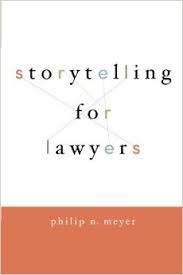
UnknownPhilip N. Meyer, professor at Vermont Law School and author of Storytelling for Lawyers, recently published an article on abajournal.com titled Going beyond the evidence to spin a story for your jury.  In his article, Professor Meyer makes the case that effective storytelling can persuade a jury to interpret the evidence in a manner favorable to the storyteller.  Consider Professor Meyer’s example from his book of Connecticut defense attorney Jeremiah Donovan’s artful closing argument in a complex murder case:

Louie Failla—one of eight co-defendants, reputed members of the Connecticut faction of the Patriarca crime family—was charged with multiple counts of racketeering in federal court in a 13-week trial. The most serious charge against Failla, a low-level soldier and driver for the leadership of the family, was for conspiracy to murder Tito Morales, his daughter’s former boyfriend and the father of Failla’s grandson.

Two mob informants had testified against Failla. But the most damaging testimony against Failla came from his own mouth. His Cadillac had been bugged by the FBI, and Failla was a man condemned by his own words. In surveillance tapes played at trial, Failla’s gravelly voice is heard plotting Morales’ execution under orders of the cruel mob boss Billy “the Wild Guy” Grasso, along with the two mob henchmen who also testified against Failla.  

*     *     *

In his closing argument, . . . Donovan depicts Failla as a “verbal chameleon,” a narrative trickster, torn between the demands of his adopted mob family on one side and his love of his real family, including Morales, on the other.

*     *     *

In Donovan’s counterstory, Failla merely pretends to go along with the murder conspiracy in order to stall the other mobsters, but he does nothing to carry out the execution.

Although having solid evidence to contradict the opposing facts is best, when presented with one set of facts, as in the example above, it is important to remember that most facts can be interpreted more than one way.  And, interpreting those facts in the context of a plausible story can go a long way to persuade the fact-finder to rule in your favor.

Related article:

Posted in Tips | Tagged , , , , , , , | Leave a comment

Don’t Bet On The Wrong Horse

We all know the importance of having an advanced health care directive so that our wishes for our health care are followed in the event we are unable to make such decisions for ourselves.  Certain types of directives call for the appointment of a health care agent, who would make our health care decisions not addressed by the directive.  When choosing this agent, be sure the decision is an informed one, so you don’t bet on the wrong horse.

220px-Refusal_of_treatment_formImagine you select a person to serve as your health care agent because he/she is a physician.  On the surface, that might seem like a wise choice.  But what if he/she ends up advocating that a dementia patient be heavily sedated in a facility rather than placed in a program that seeks to stimulate the mind to preserve the patient’s quality of life for as long as possible?

Or, imagine you select a relative to serve as your health care agent, but the two of you are extremely close, and he/she cannot bear the thought of your passing.  Selecting that relative might result in an unwillingness to allow the doctors to let you pass comfortably and peacefully in an effort to hold on.

These mental incapacitation and end of life issues are difficult, but the decisions you make now can be crucial later.  Be thoughtful about the person you choose and be honest with yourself about whether that person shares your views regarding your care.  For a decision as important as this, you don’t want to bet on the wrong horse.

Posted in Tips | Tagged , , , , , , , | Leave a comment

Thinking of Representing Yourself? Do Your Homework

So you received a traffic ticket that requires you to appear in court, and you are thinking of representing yourself.  Depending on the severity of the possible penalties (fine, points and even jail time), going it alone should be carefully considered, and it is vital that you do your homework.

New_Jersey_State_Police_Traffic_StopFirst, see if the traffic court has an online case search.  If so, you likely can search the traffic cases by hearing date and can prepare a spreadsheet of similar offenses and outcomes over the last few months.  Often the case search will allow you to click on each case to view the particulars, including the original infraction, the amended charge and plea, the fine, court costs and jail time.

  • How many judges in that jurisdiction rule on traffic cases?  If that information is not listed on the online search, it may be on the court website or you can call the court clerk.
  • How does each judge appear to rule – lenient or strict?
  • If a possible consequence of your infraction is jail time, how often did the judge hand down jail time as a sentence to others with the same infraction?
  • How many of the defendants were represented by counsel and who were they?
  • Did the defendants who were represented by counsel end up with better deals than those who represented themselves?
  • What is the fine for your infraction and how many points would be involved in pleading guilty?
  • What are the possible amended charges and fines for your type of infraction?
  • How many points are associated with each type of amended charge?

Second, consider calling the attorneys who are listed on the case search. Sometimes attorneys will give free consultations.  How much do they charge for their services and what would their strategy be?

Third, if you have a good driving record, get a copy from your local Department of Motor Vehicles and bring a copy with you to court.  Sometimes the prosecutor and/or judge will be more lenient if you have a good driving record.

Fourth, call the prosecutor’s office and see if he/she will discuss a plea in advance of the court date.  Alternatively, ask the court clerk if the judge allows time for the prosecutor to speak with defendants before having their case called on their hearing date.

Finally, if possible, sit in on a hearing before the judge assigned to your case in advance of your court date.  This will allow you to become familiar with the judge, the prosecutor, court procedure and possible outcomes.

Whether to go it alone in traffic court can be a big decision.  Before you decide, make sure to do your homework so your decision can be an informed one.


Posted in Tips | Tagged , , , , , , , | Leave a comment

Summer Holiday

images-5


LPR will be closed through the end of August for our summer holiday.

The blog will resume after our return in September.

We wish everyone a relaxing and rejuvenative remainder of the summer.

Posted in Uncategorized | Tagged | Leave a comment

Should You Pay For Attorney Mistakes?

Patrick Lamb, an attorney and blogger, wrote about attorney mistakes in his August 6, 2015 post on abajournal.com titled “How lawyers can embrace mistakes.”  In his piece, Mr. Lamb suggests that lawyers and law firms should conduct “After Action Assessments,” to evaluate “What Went Well” and what to “Take A Look At.”  He advocates sharing the assessments with colleagues so others can learn from the mistakes.  Two of the commentators, however, raised a host of possible concerns and repercussions, including malpractice concerns with admitting mistakes and ethical issues raised by disclosure requirements.

MISTAKESWhat Mr. Lamb and the commentators do not address is whether attorneys should charge their clients for fixing their mistakes. Imagine a situation where an attorney is handling a contentious divorce and a deal is struck on the couples’ division of property. After the agreement is signed, the attorney realizes that because he failed to include a particular term, the other spouse is able to wiggle out of the agreement and litigation ensues.  Should the attorney disclose the mistake to his client?  Should he charge the client for work that would not have been necessary but for his mistake?

It’s a complicated question for attorneys as it would involve disclosing the mistake to the client, which as Mr. Lamb’s commentators note raises a whole host of issues.  But, if the attorney fails to “admit” the mistake, his non-disclosure and subsequent charges to the client for the litigation in the hypothetical above likely pose ethical issues as well.

Legal consumers who find themselves in such a situation need to consider whether they should pay for their attorneys’ mistakes.  While the simple answer is “no,” unfortunately, sometimes the reality of taking that position is not so simple.


Posted in Reform | Tagged , , , , , , , , , | Leave a comment

If It Can Happen To Tom Brady . . . It Can Happen To You

Tom Brady learned a hard lesson about forum shopping this week.  He and the NFL Players Association (“NFLPA”) filed a lawsuit on Wednesday in the U.S. District Court for the District of Minnesota over his four game suspension for his alleged role in the under inflation of footballs in the AFC Championship game.  However, the NFL preemptively filed first on Tuesday in the U.S. District Court for the Southern District of New York just after the NFL Commissioner handed down his decision on Brady’s appeal. The judge in Minnesota transferred the case to New York.

Tom Brady

Tom Brady

According to a July 31, 2015 Yahoo! Sports article titled, Brady lawsuit transferred from Minnesota to New York court, Brady and the NFLPA wanted the case in Minnesota because Minnesota Viking player Adrian Peterson had received a favorable ruling from the Minnesota court against the NFL on his suspension. Minnesota Judge Richard Kyle found that the case should go forward in New York given the lack of ties to Minnesota: the NFL is headquartered in New York, the NFLPA is headquartered in Washington, Brady plays in Massachusetts, and both the arbitration and award were held/issued in New York.

[The court] sees little reason for this action to have been commenced in Minnesota at all. . . . [The court] strongly suspects the union filed in Minnesota because it has obtained favorable rulings from this court in the past on behalf of its members.

It is important for legal consumers to understand that while a court must have “jurisdiction” over a matter, “venue” must also be proper.  And, in cases where two courts have jurisdiction and both are proper venues, it can be a race to the courthouse because in that instance, the court in which the case is “first filed” will be granted deference by the other court.

Jurisdiction and venue can be complicated and should be thoroughly considered.  Because if it can happen to Tom Brady and the NFLPA with their team of high-priced lawyers . . . it can happen to you.

Posted in Tips | Tagged , , , , , , , , , , | Leave a comment

If It Can Happen To Bill Cosby . . . It Can Happen To You

Last week, The New York Times obtained a copy of Bill Cosby’s deposition from a 2005 sexual assault and defamation case that was reportedly subject to a confidentiality agreement.  According to a July 22, 2015 abajournal.com article titled Cosby lawyers blame his accuser for release of his deposition by court reporting service, Mr. Cosby’s attorneys argued in motions practice that the plaintiff in the 2005 case hired the court reporter, and it was the plaintiff’s responsibility to ensure that the court reporter maintained the confidentiality of the deposition transcript.

UnknownBecause the facts surrounding the language of the confidentiality agreement are sketchy at best, we do not know whether plaintiff’s counsel failed to adhere to and properly implement the agreement, or whether defendant’s counsel failed to take steps to ensure that his client’s deposition was secure from disclosure.  But the fact remains that the deposition was disclosed, in its entirety.  For legal consumers — and for all lawyers — this should serve as a cautionary tale.

When properly drafted and implemented, confidentiality agreements (between the parties) and protective orders (sanctioned by the court) can ensure the secure handling of confidential material.  Confidentiality agreements should provide explicit and detailed language regarding the disclosure of discovery, including discovery that is in the possession of a third-party, like a court reporter.  All discovery subject to a confidentiality agreement should be clearly marked with some “CONFIDENTIAL” designation on every page, including the originals and all copies.

The parties should consider seeking a court order protecting the confidential material so that non-parties cannot obtain the documents from the court record or from third-parties.  A copy of the confidentiality agreement and/or protective order, or at least a letter detailing their terms, should be provided to any third-party in possession of confidential documents.  The letter should also include a protocol for ensuring that the third-party does not make an inadvertent disclosure.  And steps should be taken to ensure that the documents are destroyed at case conclusion or remain protected after the litigation ends.

There are many ways to protect confidential material, and each jurisdiction has its own rules and practices.  Legal consumers should be mindful of the dangers of not having a thorough and strategic protection plan.  After all, if it can happen to Bill Cosby . . . it can happen to you.

Posted in Tips | Tagged , , , , , , , , , | Leave a comment

How Do Law Firms Hire Attorneys . . . And Why Should You Care?

So, how do law firms hire attorneys?  Well, according to University of Colorado Law School Dean Philip Weiser, law firms seek to hire attorneys based on pedigree: those who went to the best law schools and got the highest grades.  In his July 15, 2015 article posted on abajournal.com titled “How law firms are innovating when it comes to hiring,” he makes the case that this method of hiring often leads to poor results.

images-4Dean Weiser advocates that law firms should change their hiring practices from centering on pedigree.  Among other anecdotes, he cites to Google’s findings that candidates’ GPAs are “worthless as a criteria for hiring.”  Rather, he suggests that a more informed hiring practice could identify the best candidates.  For example, firms could conduct behavioral interviews centering around group projects and writing assignments, or they could use behavioral panel interviews that culminate with an onsite writing assignment “summarizing legal information for a non-lawyer.”

Psychologist Ron Friedman believes that “interviews are a disastrous tool for gauging potential . . . because over 80% of people lie during interviews.”  According to an April 22, 2015 Business Insider article titled, “Psychologist says interviews are a terrible way to hire – here’s what you should do instead,” interviewers’ own biases can affect the process.

‘We automatically jump to all kinds of erroneous assumptions about a candidate from their appearance,’ [Dr. Friedman] says. ‘Studies show we view good looking people as more competent. We perceive tall candidates as having greater leadership potential. And we assume deep-voiced candidates are more trustworthy.’

None of these evaluations are necessarily accurate, of course. ‘But here’s the thing,’ Friedman says. ‘They affect the questions we ask during interviewers. And the way a question is phrased can make all the difference.’

Dr. Friedman, author of The Best Place To Work, suggests that job auditions are better indicators of a candidate’s potential than job interviews.

Instead of asking a job candidate questions for an hour, design a job-relevant assignment that reflects the type of work the applicant will actually do, should they be hired.  

All of this is interesting, but why should you care?  If you’re a law firm partner in charge of hiring, you should seriously consider the perspective presented by these and other professionals to enhance your hiring practices and ultimately your talent pool.

If you’re a legal consumer, dispel yourself of the notion that pedigree is necessarily an indicator of a better attorney.  While a Harvard Law graduate may well be an excellent attorney, an attorney who graduated from a law school you have not heard of may also be an excellent attorney.  A high-ranking law school diploma is no guaranty.

Posted in Tips | Tagged , , , , , , , , | Leave a comment